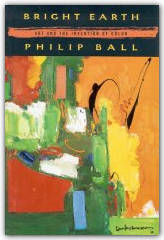
 Publicist Karli Goldman works for FSB Associates, a leading internet book marketing company. Her current projects include BRIGHT EARTH, a glimpse into a little explored avenue in the history of art and science: the creation of pigments and dyes and their influence on painting as well as on fasion, merchandising and the textile and chemical industries...
The following is an excerpt from the
book Bright Earth: Art and
the Invention of Color by Philip Ball. Published by Farrar, Straus and Giroux, February 2002 Copyright © 2001 Philip Ball
THE EYE OF THE BEHOLDER
THE SCIENTIST IN THE STUDIO
"The starting point is the study of
color and its effects on men." -- Wassily Kandinsky (1912), Concerning the Spiritual in Art
"Then the man in the blue suit reaches
into his pocket and takes out a large sheet of paper, which he carefully
unfolds and hands to me. It is covered with Picasso's handwriting --
less spasmodic, more studied than usual. At first sight, it resembles a
poem. Twenty or so verses are assembled in a column, surrounded by broad
white margins. Each verse is prolonged with a dash, occasionally a very
long one. But it is not a poem; it is Picasso's most recent order for
colors . . .
"For once, all the anonymous heroes of
Picasso's palette trooped forth from the shadows, with Permanent White
at their head. Each had distinguished himself in some great battle --
the blue period, the rose period, cubism, 'Guernica' . . . Each could
say: 'I too, I was there . . .' And Picasso, reviewing his old
comrades-in-arms, gives to each of them a sweep of his pen, a long dash
that seems a fraternal salute: 'Welcome Persian red! Welcome emerald
green! Cerulean blue, ivory black, cobalt violet, clear and deep,
welcome! Welcome! ' "
--Brassaï (1964), Picasso and Company
I believe that in the future, people will
start painting pictures in one single color, and nothing else but color."
The French artist Yves Klein made this remark in 1954, before embarking on
a "monochrome" period in which each work was composed from just a single
glorious hue. This adventure culminated in Klein's collaboration with
Paris paint retailer Édouard Adam in 1955 to make a new blue paint of
unnerving vibrancy. In 1957 Klein launched his manifesto with an
exhibition, "Proclamation of the Blue Epoch," that contained eleven
paintings in his new blue.
By saying that Yves Klein's monochrome art
was the offspring of chemical technology, I mean something more than that
his paint was a modern chemical product. The very concept of this
art was technologically inspired. Klein did not just want to show us pure
color; he wanted to display the glory of new color, to revel in its
materiality. His striking oranges and yellows are synthetic colors,
inventions of the twentieth century. Klein's blue was ultramarine, but not
the natural, mineral-based ultramarine of the Middle Ages: it was a
product of the chemical industry, and Klein and Adam experimented for a
year to turn it into a paint with the mesmerizing quality the artist was
seeking. By patenting this new color, Klein was not simply protecting his
commercial interests but also hallmarking the authenticity of a creative
idea. One could say that the patent was a part of his art.
Yves Klein's use of color became possible
only when chemical technology had reached a certain level of maturity. But
this was nothing new. For as long as painters have fashioned their visions
and dreams into images, they have relied on technical knowledge and skill
to supply their materials. With the blossoming of the chemical sciences in
the early nineteenth century it became impossible to overlook this fact:
chemistry was laid out there on the artist's palette. And the artist
rejoiced in it: "Praise be to the palette for the delights it offers . . .
It is itself a 'work,' more beautiful, indeed, than many a work," said
Wassily Kandinsky in 1913. The Impressionist Camille Pissarro made the
point forcefully in his Palette with a Landscape (1878), a pastoral
scene constructed directly on his palette by pulling down the bright
colors dotted around its edges.
The Impressionists and their descendants
-- van Gogh, Matisse, Gauguin, Kandinsky -- explored the new chromatic
dimensions opened up by chemistry with a vitality that has arguably not
been equaled since. Their audiences were shocked not only by the breaking
of the rules -- the deviation from "naturalistic" coloration -- but by the
sight of colors never before seen on canvas: glowing oranges, velvety
purples, vibrant new greens. Van Gogh dispatched his brother to acquire
some of the brightest, most striking of the new pigments available and
wrought them into disturbing compositions whose strident tones are almost
painful to behold. Many people were dumbfounded or outraged by this new
visual language: the conservative French painter Jean-Georges Vibert
rebuked the Impressionists for painting "only with intense colors."
It was a complaint that echoes back
through the ages, to be heard whenever chemistry (or foreign trade, which
also broadens a culture's repertoire of materials) has made new or
superior colors available to painters. When Titian, Henry James's "prince
of colorists," took advantage of having the first pick of the pigments
brought to the thriving ports of Venice to cover his canvases with
sumptuous reds, blues, pinks, and violets, Michelangelo remarked sniffily
that it was a pity the Venetians were not taught to draw better. Pliny
bemoaned the influx of bright new pigments from the East to corrupt the
austere coloring scheme that Rome inherited from classical Greece: "Now
India contributes the ooze of her rivers and the blood of dragons and of
elephants."
That the invention and availability of new
chemical pigments influenced the use of color in art is indisputable. As
art historian Ernst Gombrich says, the artist "cannot transcribe what he
sees; he can only translate it into the terms of his medium. He, too, is
strictly tied to the range of tones which his medium will
yield."
So it is surprising that little attention
has been given to the matter of how artists obtained their colors, as
opposed to how they used them. This neglect of the material aspect of the
artist's craft is perhaps a consequence of a cultural tendency in the West
to separate inspiration from substance. Art historian John Gage confesses
that 'one of the least studied aspects of the history of art is art's
tools." Anthea Callen, a specialist on the techniques of the
Impressionists, makes a stronger criticism:
Ironically, people who write on art
frequently overlook the practical side of their craft, often
concentrating solely on stylistic, literary or formal qualities in their
discussion of painting. As a result, unnecessary errors and
misunderstandings have grown up in art history, only to be reiterated by
succeeding generations of writers. Any work of art is determined first
and foremost by the materials available to the artist, and by the
artist's ability to manipulate those materials. Thus only when the
limitations imposed by artists' materials and social conditions are
taken fully into account can aesthetic preoccupations, and the place of
art in history, be adequately understood.
One might expect the "craft" aspects of
art to suffer less neglect when the use of color is under discussion, for
surely the nature of materials should then come naturally to the fore. But
it is not always so. Faber Birren admits in his classic History of
Color in Painting that "the choice of colors for a palette or palettes
is not in any way concerned with chemistry, or with permanence,
transparency, opacity, or any of the material aspects of art." This
extraordinary omission of the substantial dimension of color is surely the
precondition for such absurdities as Birren's assigning cobalt blue to the
palette of Rubens and his contemporaries almost two centuries before its
inventions. In view of the attention that Birren gives to the hues
required for a "balanced palette," it is indeed odd how little concerned
he is with whether artists of different eras had access to them.
PAINT AND THE PAINTER
Every painter must confront the question:
What is color for? Bridget Riley, one of the modern artists most
concerned with color relationships, has expressed the dilemma very
clearly:
For painters, colour is not only all
those things which we all see but also, most extraordinarily, the
pigments spread out on the palette, and there, quite uniquely, they are
simply and solely colour. This is the first important fact of the
painter's art to be grasped. These bright and shining pigments will not,
however, continue to lie there on the palette as pristine colours in
themselves but will be put to use -- for the painter paints a picture,
so the use of colour has to be conditioned by this function of picture
making . . . The painter has two quite distinct systems of colour to
deal with -- one provided by nature, the other required by art --
perceptual colour and pictorial colour. Both will be present and the
painter's work depends upon the emphasis they place first upon the one
and then upon the other.
This is not a contemporary conundrum but
one that has confronted artists of all eras. And yet there is something
missing from Riley's formulation of the artist's situation. Pigments are
not "simply and solely colour" but substances with specific
properties and attributes, not least among them cost. How is your desire
for blue affected if you have just paid more for it than for the
equivalent weight in gold? That yellow looks glorious, but what if its
traces on your fingertips could poison you at your supper table? This
orange tempts like distilled sunlight, but how do you know that it will
not have faded to dirty brown by next year? What, in short, is your
relationship with the materials?
Raw color supplies more than a physical
medium from which artists can construct their images. "Materials influence
form," said American artist Morris Louis in the 1950s; but
influence is too weak a word when we are faced with the explosive
vibrancy of Titian's Bacchus and Ariadne (1522-1523), Ingres's
Odalisque with a Slave (1839-1840), or Matisse's Red Studio
(1911). This is art that follows directly from the impact of color, from
possibilities delimited by the prevailing chemical technology.
But although technology made Yves Klein's
monochromes possible for the first time, it would be meaningless to
suggest that Rubens did not paint them because those colors were not
available to him. It is equally absurd to suppose that, but for a
technical knowledge of anatomy and perspective and the chemical prowess to
extend the range of pigments, the ancient Egyptians would have painted in
the style of Titian. Use of color in art is determined at least as much by
the artist's personal inclinations and cultural context as by the
materials at hand.
So it would be a mistake to assume that
the history of color in art is an accumulation of possibilities
proportional to the accumulation of pigments. Every choice an artist makes
is an act of exclusion as well as inclusion. Before we can gain a clear
understanding of where technological considerations enter the decision, we
must appreciate the social and cultural factors at work on the artist's
attitudes. In the end, each artist makes his or her own contract with the
colors of the time.
*Endnotes have been
omitted
Copyright © 2001 Philip Ball
Click on the links below
to order from
Amazon.com
Borders.com
Barnes
and Noble.com
or visit your local
bookseller
FSB Associates
http://www.fsbassociates.com
68 North Finley Avenue, Suite A
Basking Ridge, NJ 07920
Phone (908)204-9340 Fax (908)204-9341
Providing Internet Marketing Services to the Publishing Industry
