
Daniel Bain, University of Pittsburgh
In May, newly drafted Pittsburgh Steelers offensive guard Gennings Dunker amused Pittsburgh residents during a news segment, asking whether it was OK to swim in the rivers or eat the fish he planned to catch.
The live reaction – surprise, laughter and more than a little uncertainty about the right answer – revealed something the Pittsburgh Water Collaboratory encounters regularly in its public outreach: Many Pittsburghers aren’t sure whether their rivers are safe. https://www.youtube.com/embed/jB9zs62YPfY?wmode=transparent&start=0 New Steeler Gennings Dunker shares his hopes that Pittsburgh’s rivers are good for swimming and fishing.
Pennsylvanians have invested over US$1 billion in state funding over the past four years to restore the Chesapeake Bay’s watershed quality and ecosystem health. Up north, policymakers in the U.S. and Canada are working together to keep the Great Lakes intact.
Pennsylvania residents have a legal right to fishable, swimmable waterways – a standard the rivers of Pittsburgh have not always met.
As an associate professor of geology and environmental science, I study how human activity reshapes waterways and urban landscapes. My field work with the Pittsburgh Water Collaboratory tracks changes in the city’s streams and rivers over time.
The 3 rivers are improving
Fifty years ago, a fish population survey caught all of the fish in the Braddock Locks, one of the nine organizational structures of the Monongahela River, and found a single fish. One fish.
In 2010, during a similar survey, over 23,000 fish, including 32 different species, were found.
That recovery is significant, though fish populations alone don’t determine whether a river is safe for swimming.

“Swimmable” waters are a technical designation decided by regulators – primarily the Environmental Protection Agency and Pennsylvania’s Department of Environmental Protection – who estimate contamination thresholds above which swimming poses a meaningful health risk. Below those thresholds, a body of water is considered safe – though individuals still make their own calculations.
Pittsburgh’s rivers are a challenge
Dunker played college football in Iowa City, so the Iowa River offers a useful comparison. It has its own water quality problems, including dissolved nitrogen from fertilizer runoff and hog waste. But in this case, nitrogen is primarily a concern if you’re drinking the water, not swimming in it.
Whether a river is officially “swimmable” and whether you want to swim in it are two different questions.
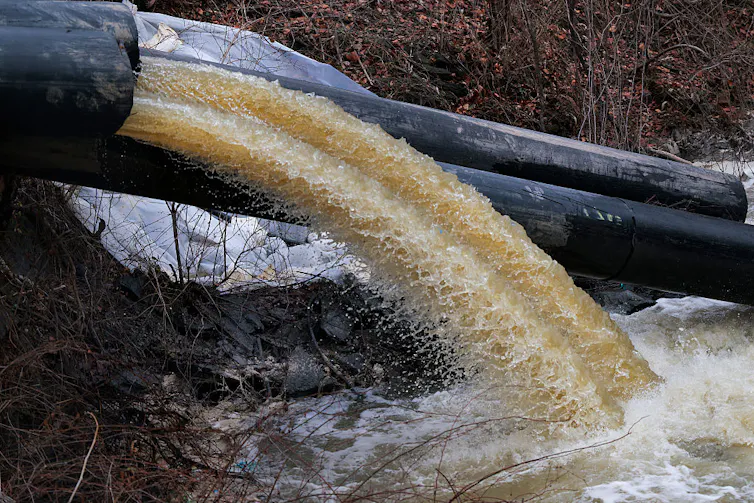
Pittsburgh’s situation is more complicated, and it comes down to sewage.
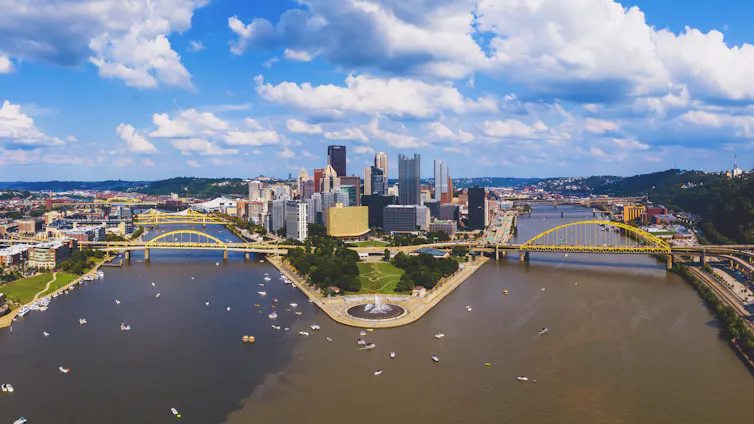
The city has inherited hundreds of sewer overflow points throughout the city’s three rivers – the Allegheny, Monongahela and Ohio. There are hundreds of points in the sewer network where heavy rain pushes a mixture of stormwater and raw sewage directly into the water. The Allegheny County Sanitary Authority, or ALCOSAN, is the regional sanitary authority. It says overflows can occur with as little as a tenth of an inch of rain.
The potential for exposure to raw sewage makes rivers in the ALCOSAN service area unswimmable for at least 48 hours after rainstorms. The consequences of this are historically well documented.
In 2002, a city councilor promoting the Pittsburgh Triathlon had to swap the swim leg for a bike leg after an overflow. In 2013, triathlon racers reportedly fell ill after competing following a storm. The 2016 triathlon became a “duathlon” – the swimming portion was canceled entirely.

ALCOSAN warns of overflow impacts with orange flags at key points along the rivers. Swimming during these periods carries a meaningful risk of raw sewage exposure. For more precise information, Three Rivers Waterkeeper, a nonprofit that helps protect and restore the water quality of the Allegheny, Monongahela and Ohio rivers and their surrounding watersheds, samples the rivers and tributaries weekly each summer as part of its Swim Guide program.
Ultimately, ALCOSAN is working toward making overflows rare, though their planning horizon for these efforts stretches to 2046.
Even if Dunker retires as a beloved Steeler, the rivers at that point will likely still be unswimmable after rainstorms.
When is it safe to swim?
Even during dry stretches, Pittsburgh’s rivers carry the legacy of their industrial past.
Abandoned coal mines and slag piles – mountains of waste left over from steel, mining and coal operations – continue to contribute dissolved materials to southwestern Pennsylvania waters. And like nitrogen, their risks to a swimmer aren’t well understood. People are left making a personal call without much guidance.
Fishing has clearer direction. Pennsylvania issues specific advisories on how much fish you can safely eat from a given stretch of river. These advisories account for that lingering contamination.

Dunker’s enthusiasm for the possibility of fishable, swimmable rivers shows us what could be.
Those who have lived in Pittsburgh for years have witnessed incidents, including oil spills and sewage overflows, that invite skepticism about river safety. But as we witness the city’s rivers steadily improve, some of us wonder whether they indeed will be fishable and swimmable in the near future.
The march toward cleaner, healthier rivers continues, and I believe joyous optimism like Dunker’s fuels this progress. But until we get there, Pittsburghers will all experience periods where we cannot freely fish or swim in the rivers that define the city.
Daniel Bain, Associate Professor of Geology & Environmental Science, University of Pittsburgh
This article is republished from The Conversation under a Creative Commons license. Read the original article.

