
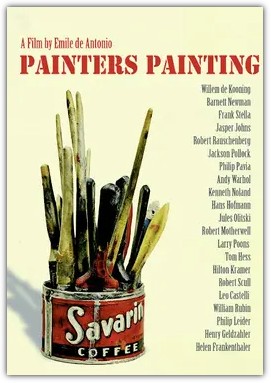
Painters Painting by Emile de Antonio
A documentary film about postwar American painting combines footage of museum shows with interviews with the artists themselves. Besides covering Abstract Expressionism in depth, the film discusses other significant 20th-century art movements, such as color-field painting and Pop Art.
Likely the best most informative film on the birth of American Abstract Expressionism. Artists appearing in the film are Willem de Kooning, Jasper Johns, Andy Warhol, Robert Rauschenberg, Helen Frankenthaler, Frank Stella, Barnett Newman, Hans Hofmann, Jules Olitski, Philip Pavia, Larry Poons, Robert Motherwell and Kenneth Noland.
It covers the American art movement beginning at post WWII through the 1960’s with Andy Warhol. The entire film was superb, you had the opportunity to visit the artist’ work space and listen to their thoughts on art and how they came upon their individual styles.
No actors, no stand-in, and it’s not a biography. The actual artist is who you watched and heard speak. Each artist interviewed were captivating but the most interesting segments included Barnett Newman and Robert Motherwell. I later found out Barnett Newman studied Philosophy at City College of New York while Robert Motherwell studied Philosophy at Stanford University. When you listen to both speak in contemplative, rational and stoic terms, it all makes sense.
It was fascinating to learn the what, the how, and the why of their work/life. For Abstract Artists, we can thank that entire generation of artists that opened the door. We can thank them for making the general public aware that art is more than a misty morning bridge or bright red apple or exquisite portrait painting. It’s the best film I’ve seen and the only other one I really like, The Mystery of Picasso, but that’s for another post.
Abstract Expressionism is a term applied to a movement in American painting that flourished in New York City after World War II, sometimes referred to as the New York School or, more narrowly, as action painting. The varied work produced by the Abstract Expressionists resists definition as a cohesive style; instead, these artists shared an interest in using abstraction to convey strong emotional or expressive content. MOMA
As of this writing I cannot find any free streaming, but this is a good trailer, it’s the only trailer/excerpt I found. I first watched the movie years ago on Prime free and decided to buy it and I watch it over again when I’m out of fresh ideas and inspiration.
**Side Note – Since watching he movie, I have tracked Frank Stella’s work through the years and amazed how his work morphed from extreme minimalism to the opposite end, where he now describes himself a maximalist. Frank Stella through the years
- More on film maker Emile de Antonio